Available now in ebook
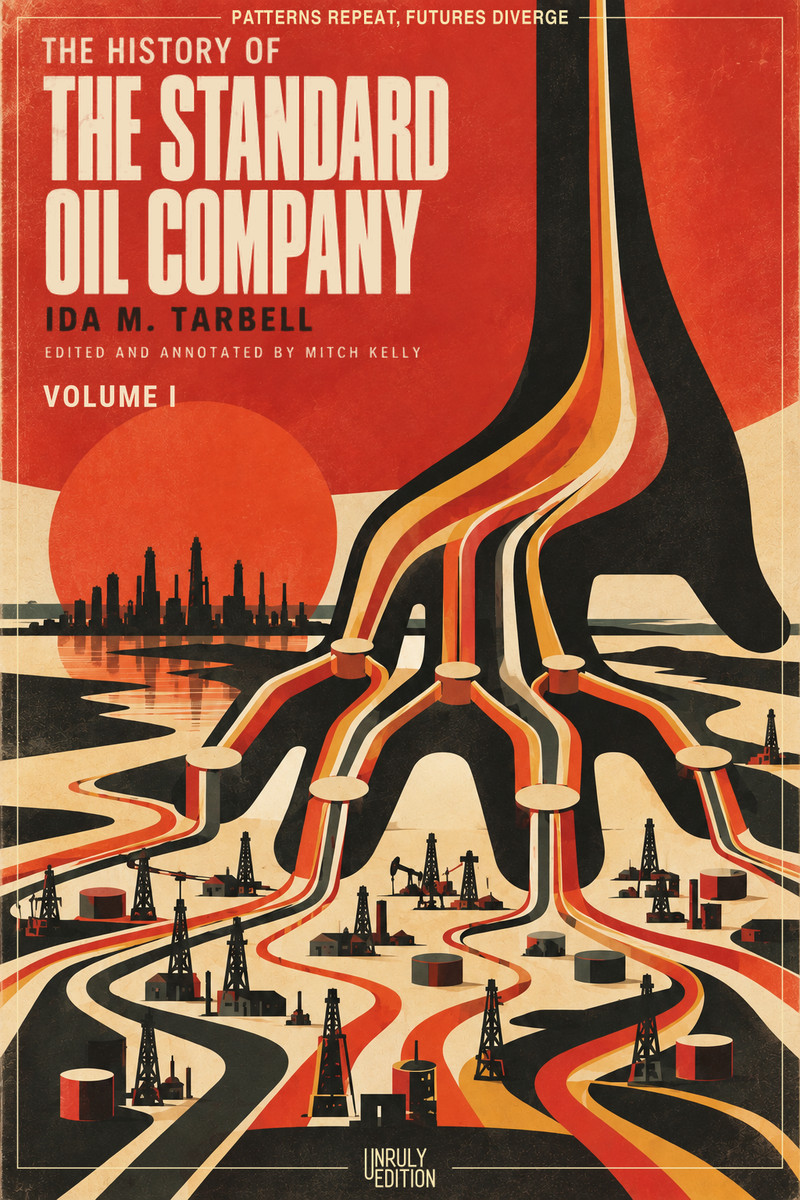
Volume I
Chapters 1–8 and four new essays. The oil boom, Standard’s rise, and the outsiders whose discoveries built the industry.
Read the forewordChapters 1–8 and four new essays. The oil boom, Standard’s rise, and the outsiders whose discoveries built the industry.
Read the foreword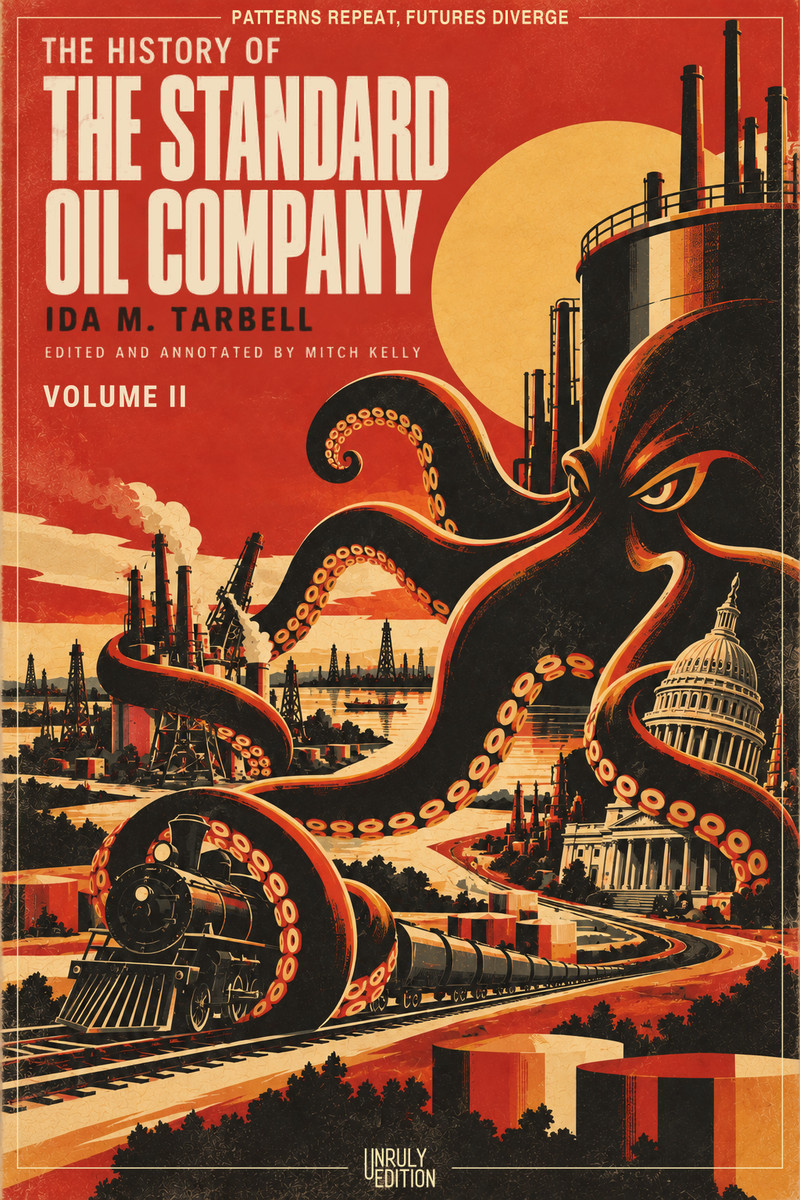
Chapters 9–18 and three new essays. Standard at the height of its power, and what changes when intelligence helps people build their own alternatives.
Edited and Annotated by Mitch Kelly
Standard Oil controlled the routes between producers and their customers. These annotated volumes ask what happens when the same struggle moves from oil to intelligence.
Tarbell follows the contracts, railroad rebates, pipelines, and political influence that made Standard Oil dominant. Mitch Kelly’s seven new essays and extensive annotations connect that record to AI, citizen science, privacy, and the people building a way around today’s gatekeepers. The notes also present the strongest opposing arguments so readers can judge the case for themselves.
Volumes I and II are published separately.
From the book
Read the foreword
Volume I · Foreword by Mitch Kelly
Before the first pipelines, the oil of western Pennsylvania left the valley in wagons hauled by teamsters, men who drove teams of horses for hire. The teamsters owned no wells and no oil. They owned their horses, their wagons and, for a few years, the only practical way out, and on bad roads they could charge more to haul a barrel a few miles than the oil inside it was worth.
The teamsters raise the question that runs through this book. What does a dominant firm actually own, and what only looks like ownership because everyone has to travel through its route? Standard Oil, the company John D. Rockefeller built, owned refineries. So did its rivals. What it held that they did not was the pipe from the wells, the terminal at the seaboard and the contract with the railroad. The hand on this volume's cover holds no barrel. Its fingers are pipelines and rail lines, and it closes where they meet. The cartoon that opens the book, drawn in 1900, shows Rockefeller holding the White House in the palm of his hand.
Today, the most capable artificial intelligence runs on models and data centers that a few companies own, and every business built on them builds on terms those companies can change. In medicine, the firms that decide which drugs a health plan will cover manufacture none of them, and the legal route for bringing cheaper medicine in from Canada took more than twenty years to open on paper. In each case the asset that matters is the passage, not the product.
Ida Tarbell answered the question for oil with documents, which is why her answer is still worth reading. She grew up in the Oil Regions, the oil country of northwestern Pennsylvania, a child of the boom her first chapter describes. As a journalist for McClure's Magazine she spent years assembling court records, sworn testimony before legislatures and Congress, company papers and interviews into a history that ran in the magazine from 1902 to 1904 and appeared as these two volumes in November 1904. Some of the interviews took place inside Standard Oil itself. For about two years from 1902 she met Henry H. Rogers, one of the company's vice presidents, at its headquarters at 26 Broadway in New York, and tested what she had found against what he would tell her. Then she printed the evidence. The contracts, affidavits and testimony fill the appendices of both volumes, where any reader can check her. The essays and notes in this edition argue from that record, and the record can be inspected. A reader who doubts an inference can go to the document behind it.
The notes beside her text correct her where she is wrong, complete what she leaves out, convert her sums into today's money and connect her record to the present. They do not restate her. Where she makes the point, there is no note. The strongest case against the edition's own positions appears in the notes at full strength, because an argument that cannot survive its opposition is not worth making. Nothing in her text or in the testimony she quotes has been removed or softened. Her footnotes keep their numbers. The editor's notes are marked with letters.
Why read a history of an oil company now? Because oil was the last cheap, world-changing resource, and we are living through the next one. Kerosene put bright, cheap light into ordinary houses. Machine intelligence is making drafts, answers and analysis cheap in the same way. And the mechanisms that followed cheap light are repeating. A commodity's cost collapses. A few firms spend far more than they take in to win the market. Consolidation comes through the route rather than the product. Regulation arrives late and takes the shape the largest firms prefer.
More than a hundred and fifty years after the first well, the same patterns are emerging. That is why these books matter. Nature reuses patterns. Similar pressures produce recognizably similar responses, in living things and in markets, and the pressures that shaped the oil trade are at work again. None of this is divination. A pattern recognized is not an outcome promised. What Tarbell's record offers is evidence of how things tend to turn out when the same forces are in play.
Two patterns run through it. The first is the route. Whoever holds the passage between producer and market can tax everyone who uses it, learn their business and decide who gets through. Standard played that hand, and the frontier AI companies, the few that build the most capable models, are playing it again. The second is the way around. In 1879 independent producers pumped their oil over the Allegheny Mountains through a pipe of their own. Today the way around is the open-weight model, which any company can download and run on machines it controls, and the best of them trail the strongest closed models by months.
For Standard, the first pattern won. The chapters of this volume end with the independents beaten, and within a few years Standard owned a third of the producers' pipeline and had turned its builders into partners. Do not mistake that for the end of the story. This time the way around wins faster, because the resource improves itself. Standard could absorb an outsider's discovery because turning a better process into a rival business took years of refineries, pipe, contracts and customers, and Standard used those years to make the improvement its own. Intelligence shortens the years. A model capable of doing a company's work also helps that company write the software, tests and records it keeps when it changes suppliers, and every advance the labs sell teaches others how to copy it. Demand for intelligence will keep growing. Demand for each new proprietary improvement will not. The frontier is buying capacity for a product whose demand will dry up, and every improvement it makes brings that day closer. The second volume makes that argument. This one shows the pattern it rests on.
Who builds the way around? Rarely the people who own the road. Usually it is outsiders, people the established trade did not train, fund or expect. Thomas Kuhn, the physicist turned historian of science, found the same pattern inside science itself. In The Structure of Scientific Revolutions (1962) he observed that the people who overturn a field's paradigm, the shared picture that tells its practitioners which questions are worth asking, have almost always been very young or very new to the field. Kuhn's newcomers usually worked inside the institutions of science. What made them outsiders was that their thinking was not yet bound to the old way of seeing. When a new resource arrives, oil then or machine intelligence now, the opportunities go first to outsiders of that kind, people the prevailing assumptions have not yet constrained, whether or not they hold a post. Citizen scientists are an important part of that larger group, and these books take them as its model, because they stand outside the institutions as well as the assumptions. The term means something exact. A citizen scientist is a capable investigator outside the institutions who originates the question, runs the investigation, tests the result and shares it, rather than gathering data for someone else's project. Why scientists? Because science is a method, not a credential. Asking a question of the world, testing an answer against what the world actually does and publishing the result where others can check it is science, whoever does it and wherever it is done. The universities and laboratories that now license the word came long after the method, and they never owned it. The Oil Regions ran on that kind of work before anyone had a name for it. Edwin Drake, who brought in the well that started the business in 1859, had no training for the job. The company that sent him mailed letters ahead addressed to "Colonel" Drake, to impress the people he would meet. He had never served. The skill that made the well belonged to a salt driller he hired. Of the 5,560 wells drilled in the industry's first ten years, Tarbell counts 4,374 that came up dry or were abandoned as unprofitable, nearly four failures in five, drilled for the most part by men of small means risking their own money. And when the trade needed a market, the traders made one, bargaining on the oil trains until they built exchanges.
The Oil Regions paid for discovery with money and recognized its discoverers late. Drake's well enriched other men, and his own reward came years afterward, as charity, when he was sick and broke. That order is reversing. Analysis is becoming cheap. What it cannot make cheap is attention, judgment and trust, or the readiness of other people to lend their time and their laboratories to a question that is not theirs. Money can still buy reagents, instruments and trials, and it keeps its hold on that physical remainder. A designer working with a capable model can now do much of the engineering that once took a manufacturer's own staff, but money still buys the tooling and the factory floor, and it keeps its hold on those too. It cannot buy the confidence of strangers that a piece of work is sound. That comes from a record others can check, and a reputation earned that way can command the scarce things directly. And as machines take over more of the work wages once bought, people who keep investigating will do it for motives no employer ever paid for. Curiosity drives them, and so does the pleasure of cracking something hard and the respect of peers whose judgment they trust. The citizen scientist works for reputation, not necessarily for a quick cash payout, on the premise that reputation eventually leads to favor and material benefit.
In medicine the change is sharpest. AI gives everyone else pharma's tools, and pharma has not noticed. The notes follow the argument into drug repurposing, planned trials in a single patient and the community of people who test treatments on themselves, and they keep it short, because medicine needs more room than a history of oil can give it.
Tarbell's record is a long argument between two answers to a gate. One is to petition it. The other is to build around it. The producers tried both, and the second came more naturally to them. Early on they were confident enough to declare that if the railroads' discriminations did not stop, they would build a railroad of their own. When the trade needed a way to buy and sell oil that was still sitting in pipes, it made its own money without asking anyone's leave. In 1868 the Empire Transportation Company, a freight line that also ran pipelines, began issuing certificates for oil held in its pipes, and the certificates soon became the trade's general medium of exchange. No legislature authorized that currency. Need did.
That is how these books read the record. A reasonable reader may accept some of it and reject the rest, and the notes set the strongest opposing arguments beside the book's views at full strength so that each reader can make up his or her own mind. A few strong voices helped shape these views, and I would urge the interested reader to do further research on the ones that seem unfamiliar. The book argues that their use as a lens for relating this history of oil to current and emerging times is appropriate, with the following justifications.
The producers' instinct to build around the gate never went away, and every generation gives it better tools. When strong cryptography reached ordinary computers, the programmers who called themselves cypherpunks, Eric Hughes, Timothy May and John Gilmore among them, came to the producers' conclusion by their own road. No government or company would hand people their privacy, so people would have to write it into code and give the code away. Bitcoin, proposed in 2008 under the pseudonym Satoshi Nakamoto and launched in 2009, did for payment what the certificates did for oil, letting two parties settle with no trusted intermediary between them. James Dale Davidson, an American investment writer, and William Rees-Mogg, a former editor of The Times of London, pushed the same logic toward the state in The Sovereign Individual (1997), predicting that wealth would become mobile and that people would choose among governments as customers choose among suppliers. The notes bring these arguments in where the oil record can test them.
The record also shows where building around runs out. Oil could move. Wells could not, so producers taxed to pay for the Civil War had to send delegates to Washington rather than shop for a better jurisdiction. Exit works for what can leave. And when Pennsylvania indicted Standard's officers in 1879, the ones living in New York stayed beyond its reach while Pennsylvania's governor sat on the request to bring them back. A border that shelters a person from an oppressive law can also shelter the powerful from the people they have injured.
Privacy is the harder case, because whoever holds a route can also watch everyone who travels it. Hughes drew the distinction the notes rely on. Keeping a secret is hiding something from everyone. Privacy is choosing what to show, and to whom. But choosing assumes the hiding works, and the hiding is failing. Machines already infer where a person lives and what he earns from what he writes, and the mathematics that protects most encrypted traffic today will fall to a large enough quantum computer. David Brin, a scientist, futurist and novelist whose fiction turns on what new technology does to secrecy, privacy and power, saw half of this in The Transparent Society (1998). Surveillance would spread no matter what anyone did, he argued, so ordinary people had better be able to turn the cameras on the powerful. These books go further. Sovereignty cannot ultimately depend on keeping secrets, because secrets are ending. What survives exposure is a reputation built in the open and the freedom to walk away. The second volume argues it in full.
Tarbell and these books stand together on the open field and part ways over the remedy. Her first chapter celebrates a region where anyone with a lease and some nerve could try for oil. Her reporting helped bring on the federal suit that ended, in 1911, with Standard Oil broken apart, and most readers take that breakup as the moral of her book. These books do not. Pennsylvania's constitution of 1874 forbade railroads to favor one shipper over another with rebates or any other device, and the secret rebates continued as if it had never been written. The 1911 decree divided the companies, not their ownership, and Rockefeller's fortune grew after it. The remedy is not regulation. A business that can only stand while the state holds it up has no claim to stand at all, and someone else would have met the need on market terms. What these books ask for instead is the way around, built rather than petitioned for, with reputation as the currency of trust and the fewest gates possible, preferably none.
None of this rules out coordination or temporary centralization. The stones of an arch have to be held in place until the top stone is set, and then the frame comes down. The danger is a frame that stays up and calls itself the building.
Foreword by Mitch Kelly, from Volume I of The History of the Standard Oil Company.
Copyright © 2026 Mitch Kelly.
Back to the volumesAnnounced titles, contents, formats, and publication dates are subject to change.