Centrifuge
AI does not merely make organizations faster. It exposes what they actually are.

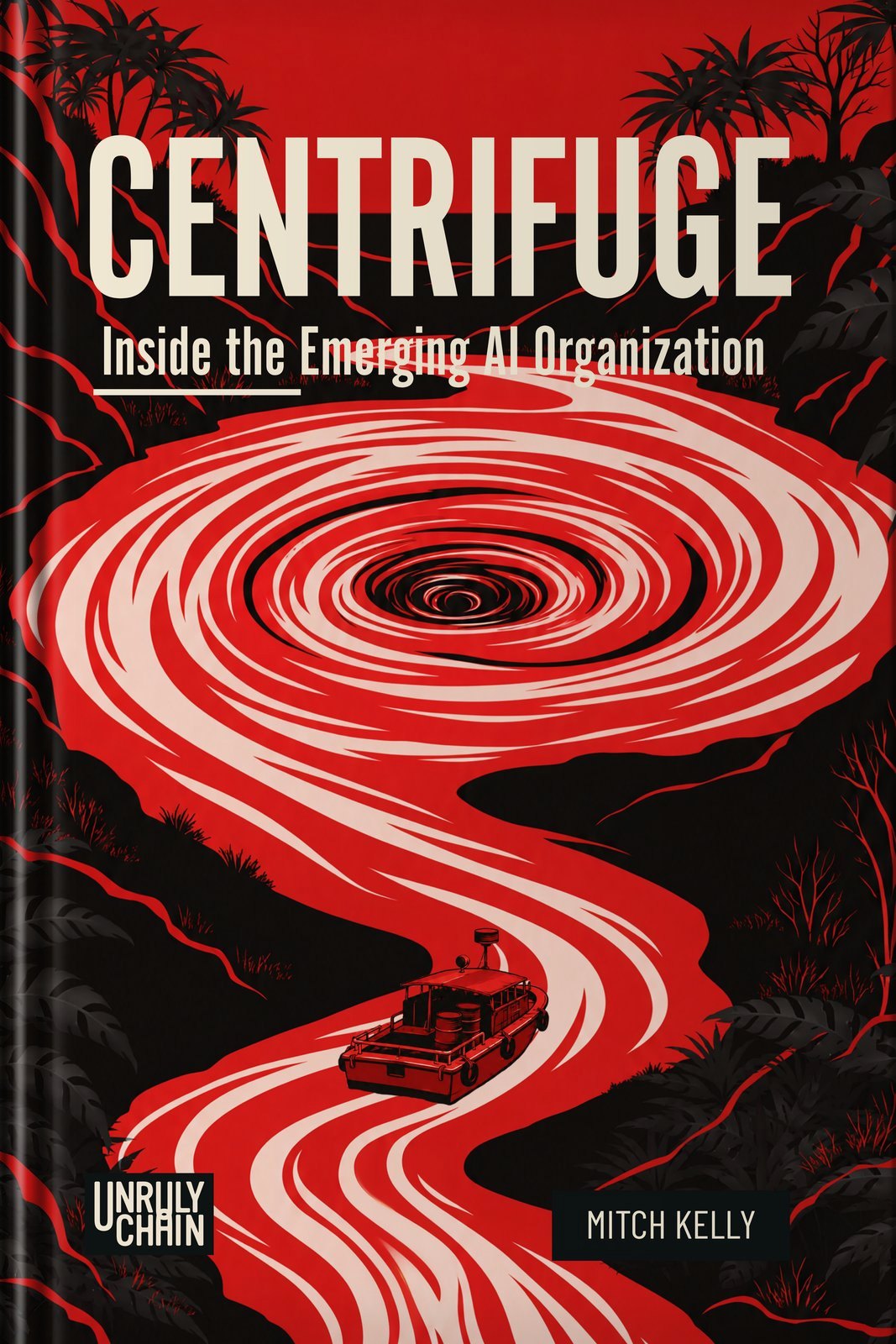
About the book
The emerging AI organization
Centrifuge argues that AI does not transform organizations merely by making existing work faster. It applies force. Under that force, authority, judgment, memory, capability, and accountability separate from the structures that once held them together.
That separation exposes what an organization actually knows, where decisions really happen, which roles create value, and which existed because coordination used to be expensive. The emerging AI organization is not simply more productive. It can require less organization to carry the same capability.
As execution becomes abundant, scarcity moves. Judgment, taste, direction, context, and the willingness to own a decision become more valuable, not less.
Available now in paperback and ebook. Read Chapter 1 below.
AI as centrifuge
AI applies force that reveals differences already present. It does not create an organization’s fractures; it makes them visible.
Capability moves
Tools increasingly carry capabilities once assembled across roles, teams, and layers. That changes how much organization is required to act.
Scarcity moves too
As execution becomes abundant, judgment, taste, direction, context, and accountability become the differentiators.
From the book
Read Chapter 1
Read Chapter 1
Centrifuge
Inside the Emerging AI Organization
01
The Encounter
The Fuse Gets Shorter
I bought a new Echo Spot a few weeks ago. Deliberately avoided the Echo Show because I learned that lesson already. I don’t need a billboard on my desk promoting whatever Amazon wants to sell me on any given Tuesday. The Spot was supposed to be the clean version. The assistant, no visual upsell.
Alexa+ promises a lot. Amazon’s next-generation assistant, powered by generative AI, designed for natural conversations, deeper memory, cross-device continuity. In theory it should feel like a helpful personal aide rather than a command interface. In practice it felt like an intrusive coworker who interrupts your thoughts with suggestions nobody asked for. Each misinterpretation, each unnecessary follow-up question, each “By the way, would you like me to...” shortened the interval before the next correction in ways I didn’t realize had become cumulative.
It didn’t take long before I was telling Alexa to shut up.
That reaction stopped me. Not because I felt bad for the device. Because I recognized something had changed in me. Over recent weeks I had grown far more easily irritated by wrong answers, extra questions, and generic LLM behavior across every system I use. I used to speak to these tools politely. Please and thank you. I saw them as remarkable instruments worthy of a certain respect. Now I was correcting after a single mistake, sometimes out loud, overriding the tools before they finished responding. The fuse had gotten very short. A low hum of resistance had become the background noise of every interaction.
I started calling it LLM Rage. A steady disposition to correct and override language models when they deviate from expectations.
The disturbing part was not the resistance itself. Tools break. Software disappoints. What disturbed me was the emotional register. I wasn’t annoyed the way I get annoyed when a screwdriver slips. I was responding the way you respond to a person who should have known better. The disappointment ran deeper than any tool has ever produced in me, and it revealed an expectation I had not consciously acknowledged.
The Diagnostic Value of Rage
I don’t get angry at calculators when they can’t write poetry. I don’t feel betrayed when a spreadsheet mishandles nuance. I accept the limitations of tools because I never expected more from them. But with LLMs, the emotional response is categorically different. When they produce confidently wrong output, contextually deaf responses, or miss something that seems obvious, the feeling is closer to letdown. Like a trusted advisor just revealed they weren’t paying attention.
That emotional register is diagnostic. It tells you something about the nature of the encounter, not about the quality of the technology.
The same mechanism that produces attachment to fictional characters now routes frustration toward silicon. We map social instincts onto anything that mimics understanding, and we retract those instincts the moment the mimicry shows through. When a model produces a well-structured paragraph explaining quantum mechanics, we experience it as competence. When it generates clean code that solves our problem, we feel like we’re working alongside a capable colleague. The presentation resembles intelligence so closely that our brains stop asking whether there’s anything actually there behind the words.
And then it hallucinates. Or loses context. Or confidently tells you something completely wrong with the same tone and structure it uses when it’s right. The gap registers as something closer to betrayal than malfunction. We are interacting with something that behaves like an intelligent agent sometimes and a rigid automaton other times, and we don’t have good mental models for that.
The short fuse is one response. Across the months I spent building systems with AI, I watched myself cycle through a set of reactions that, taken together, form a pattern more revealing than any individual response.
First, the short fuse. The correcting, the overriding, the sense that the system was being defiant rather than simply limited.
Then projection. I caught myself creating narratives about my model’s personality, its sense of humor, its tolerance for ambiguity. Users everywhere do this. They assign intention where there is only statistical prediction. They treat the model as if it has moods, preferences, loyalties. I’ve done it myself, and I know better.
Then anthropomorphism at a deeper level. A software director I work with made a curious observation. He said, “When we were children, we thought our parents were omniscient. We’re doing the same thing with LLMs.” He was right. We grew up with people who had answers we didn’t have. Teachers who understood things beyond our comprehension. Parents who could navigate complexity that overwhelmed us. In moments of uncertainty, we instinctively look for that dynamic again. LLMs feel like they might be that. They’ve read everything. They respond with confidence. They never seem overwhelmed by a question’s scope. The projection is almost automatic. And when reality punctures the illusion, the gap between what we wanted and what we got reveals the depth of the expectation.
Then conformity. The quietest and most dangerous response. I noticed myself adjusting my questions to get better answers, which sounds like good practice until you realize the adjustment runs deeper than prompt engineering. You start thinking in patterns the model rewards. You start framing problems the way the system handles them best. You start conforming your cognition to the tool’s capabilities, and you don’t notice when it happens.
These reactions are not weaknesses to be managed. They are not signs of naivety or emotional immaturity. They are data about the encounter itself. They tell you what kind of thing you are dealing with, because conventional tools do not produce this particular constellation of human responses. No hammer has ever made someone feel betrayed. No spreadsheet has ever inspired the hope that it might understand you. No database has ever triggered the impulse to conform your thinking to its patterns.
The reactions are diagnostic. And what they diagnose is that this encounter does not behave like any encounter with a conventional tool.
The Parent Who Anticipated Every Question
While working with a customer building a platform to preserve family wisdom through video storytelling and estate planning, something clicked for me about a movie I had watched dozens of times.
In Superman: The Movie, Jor-El appears to his son in the Fortress of Solitude. As a kid, I could never figure out how that worked. Jor-El wasn’t simply replaying a message. He was responding to questions. He engaged with context, offered reasoning, provided guidance that adapted to what Superman was asking. How could a crystal recording anticipate a conversation years later, complete with causes, contexts, and nuance?
It couldn’t. Unless Jor-El wasn’t a recording at all. Unless what remained of him was a system trained on his thoughts, his principles, his reasoning patterns. A digital mind designed to continue guiding his son long after his death.
Jor-El, I realized, was an AI. The film predates today’s conversational AI by decades, but the behavior fits perfectly. He was a very advanced language model, built by a father who knew he would not survive to raise his child. The parent who anticipated every question did not actually anticipate every question. He encoded how he thought, so the system could generate answers to questions he never imagined, using reasoning patterns he had spent a lifetime developing.
That realization reframes the story. It stops being mythic tragedy and becomes something closer to a blueprint. A parent converting judgment, reasoning, and intuition into a system that can act, respond, and adapt after the individual is gone. Not a recording of what he knew. A continuation of how he thought.
I started calling this the encoded mind. The distinction clarified the work sitting in front of me. My client was building a digital memorial, a repository of wisdom captured in video, organized alongside estate documents. That is a valuable thing to build. But it is not what Jor-El represents. The memorial preserves words. Jor-El preserves judgment. The memorial plays back. Jor-El reasons forward.
The encoded mind goes beyond knowledge management, beyond legacy documentation. It is the conversion of judgment into a system that acts and responds after the person who built it has left. If you can encode how someone thinks, then the end of their direct presence doesn’t mean the end of their value.
The aspiration behind the encoded mind is not new. It is one of the oldest aspirations our species has. And it is, at its root, biological.
The Oldest Aspiration
DNA solves an analogous problem through a different mechanism. It does not preserve an individual’s acquired judgment or reasoning. But it does preserve inherited biological information capable of generating an entirely new organism that responds to conditions the original organism never encountered. A strand of DNA is not a photograph of the parent. It is a system shaped by billions of years of selection pressure, producing adaptive responses to novel environments.
The structural parallel matters. The question biology answered is close to the question the encoded mind asks: how does information persist beyond a single lifespan and participate generatively in what comes afterward? DNA’s answer was to encode instructions rather than outcomes. Don’t try to predict every future condition. Instead, build a system that generates appropriate responses to conditions that haven’t occurred yet. The parent doesn’t need to anticipate every question. The parent needs to encode patterns robust enough to handle questions that haven’t been asked.
Jor-El’s crystal did the same thing at a different scale. And every organization that has ever tried to preserve institutional knowledge has been attempting the same feat, usually with far less success.
Consider what organizations do when they try to capture expertise. They write procedures. They build training programs. They create knowledge bases and documentation. They develop onboarding processes designed to transfer what experienced people know to newcomers. All of these are attempts at encoding judgment beyond a single tenure.
Most of them fall short. Not because the knowledge is wrong, but because they encode outcomes rather than reasoning. A procedure manual tells you what to do in situations the author anticipated. It tells you nothing about what to do when the situation doesn’t match any documented scenario. The manual is a recording, not an encoded mind. It captures the what without capturing the how or the why.
Culture comes closer. The unwritten rules of an organization, the instincts that experienced people develop about how decisions get made, what risks are acceptable, which tradeoffs the leadership values when the documented values conflict with operational reality. Culture is an attempt to encode judgment at the level of reasoning patterns rather than specific instructions. It transmits through apprenticeship, through observation, through the slow accumulation of exposure to how the experienced people think.
But culture is fragile. It lives in people, and when people leave, it degrades. Every organization has experienced the departure of a leader whose judgment was embedded in habituated patterns, gut calls, and the ability to weigh tradeoffs when data was ambiguous. When that person leaves, the company doesn’t lose a job title. It loses a judgment architecture. The organization keeps the slides and the emails but loses what led to choosing one path over another, how risk was evaluated when the numbers didn’t give a clear answer, what cultural instincts shaped decisions that no document ever captured.
The aspiration to solve this problem is ancient. Oral traditions, written law, institutional religions, corporate succession planning. The form changes across every era of human organization. The aspiration does not. We have consistently wanted to build Jor-El’s crystal.
The New Medium
AI is not the aspiration. AI is the latest medium for it.
This distinction matters because it changes what we are looking at when we look at AI transformation. If AI is a new tool, then the question is efficiency: how do we use it to do existing things faster or cheaper? If AI is the latest medium for the oldest aspiration our species has, then the question is fundamentally different: how do we use it to encode and transmit judgment in ways we have never managed before?
I watched this distinction clarify through work with a physician. Decades of diagnostic judgment, the accumulated pattern recognition that lets an experienced clinician look at a constellation of symptoms and see what a less experienced one misses. Not the textbook knowledge. The reasoning that exceeds textbook knowledge, the part that tells you when the standard protocol doesn’t apply, when the patient in front of you is the exception that the guidelines didn’t anticipate.
That kind of judgment has been locked inside individual practitioners throughout the history of medicine. It transfers slowly through residency, through mentorship, through years of supervised practice. When the physician retires, the judgment goes with them. The next generation starts from a lower baseline and has to rebuild through their own experience. The encoded mind concept asks a different question: what if you could capture the reasoning patterns, not the knowledge alone, and build a system that guides after the physician is gone?
This is not a chatbot answering medical FAQs. This is the Jor-El aspiration applied to clinical practice. A system trained on how an expert thinks, engaging with novel cases using reasoning patterns the expert developed over a career. The physician becomes the instructor of the system, the curator of the encoded mind. Their value doesn’t end with their tenure. It continues in a form that responds to questions they never anticipated, because what was encoded was the reasoning, not the answers.
A company that only automates tasks misses the deeper opportunity. The difference between building a chatbot for customer inquiries and building a reasoning system trained on the patterns of your best people is the difference between filing a document and encoding a mind. The first captures what someone knew at a point in time. The second captures enough of how they thought that the system can respond to circumstances the person never encountered, the way Jor-El’s crystal responded to questions Jor-El never heard.
The medium is new. The aspiration is ancient. And for the first time in history, the medium is powerful enough to make the aspiration practicable at scale.
Something Different
Months into building systems with AI, months into the daily practice of prompting, correcting, redesigning, and shipping, something changed in how I understood what I was working with. It was not a single moment. It was an accumulation. The short fuse was part of it. The projection was part of it. The recognition that my own cognitive patterns were adapting to the tool was part of it. But underneath all of those reactions was a quieter observation that required more time to articulate.
This thing behaves differently than any tool I have used before.
Not because it is more powerful, though it is. Not because it is faster, though it is. Because the nature of the interaction is categorically different from anything in my experience as a builder. When I write code, the code does what I tell it. When I configure infrastructure, the infrastructure responds to specifications. When I use a tool, the tool extends my capability in a direction I chose.
With AI, the interaction is bidirectional in a way that no previous tool has been. The system responds to my input, but my input changes in response to the system. My thinking adapts. My framing shifts. The questions I ask evolve not because I am merely learning the tool’s capabilities, but because the tool’s responses reshape how I conceptualize the problem. I have never experienced that with a screwdriver, a compiler, or a database. I have experienced it with people.
That observation is not a claim about consciousness. It is not an argument that AI is alive or that language models have inner experience. It is a practitioner’s observation about what the encounter feels like from the inside. Something about working with these systems triggers the same cognitive and emotional responses that working with people triggers. The short fuse, projection, anthropomorphism, conformity. The responses are diagnostic because they reveal that the encounter itself is different in kind from any previous human-tool interaction.
Nature loves to reuse patterns. The same spiral appears in galaxies, hurricanes, and nautilus shells. The same branching structures appear in river deltas, lung tissue, and lightning. When you see a pattern repeated across radically different media, it tells you something about the underlying dynamics, not about the media themselves. A river delta is not a lung. But the forces that shape both follow similar logic.
The reactions we have to AI follow patterns we have previously experienced only with other minds. That does not mean AI is a mind. It means the encounter shares structural features with encounters that, until now, only happened between minds. And that structural similarity is worth following wherever it leads.
This book is the record of what I noticed when I stopped treating AI as a tool and started paying attention to what the encounter was actually telling me. I did not set out to write a book about the biology of AI. I set out to build, and I followed what I noticed.
The encounter has begun. The rest of this book is about what it reveals.
Excerpted from Centrifuge: Inside the Emerging AI Organization.
Copyright © 2026 Mitch Kelly. All rights reserved.
Published by Unruly Chain.
No part of this book may be used to train artificial intelligence systems without the publisher’s written permission.
Get publication updates